Information Classification.
Build a modern foundation for data handling, DLP, and AI governance.
Build an information classification program your business will actually use.
Our information classification consulting helps security and IT leaders build right-sized, tailored programs that make data easier to protect, easier to handle, and more usable across DLP, AI governance, compliance, and everyday business operations.
Lorem ipsum dolor sit amet, consectetur adipiscing elit, sed do eiusmod tempor incididunt ut labore et dolore magna aliqua. Ut enim ad minim veniam quis nostru.
Why InfoClass systems break down.
Most classification programs fail because the taxonomy is too complex, the labels don't match how the business actually works, and nobody builds the handling rules, training, or rollout support needed to make the program usable.
Any of these sound familiar?
InfoClass sensitivity labels will fail in their deployment if your model tries to account for every edge case. If you try to include too much detail, users end up with too many choices and too little confidence. More tiers create more friction, more inconsistency, and more room for misclassification.
We can help you categorize and simplify.
Problems arise when different teams handle similar information in different ways, but the taxonomy does not reflect that reality. The result is a framework that looks logical on paper and breaks the moment people try to use it.
We design taxonomies acknowledging that business users are the primary owners of information and are best suited to label sensitive material. We also know labeling information allows IT and Security to better understand how data moves throughout and outside of your organization.
Programs fail when employees are asked to classify information without enough examples, enough context, or enough confidence in the labels. That uncertainty leads to inconsistent decisions, wasted time, and weak adoption.
Once a useful taxonomy is established, data protection controls and restrictions can be applied with precision and specific intent rather than a wide-net approach.
Our approach puts people and process first, enabling informed protection, enforceable controls, and reduced risk.
A sensitivity label alone does not tell people what to do next. If teams do not understand how classified data should be stored, shared, restricted, retained, or deleted, the label becomes decoration instead of direction.
In addition, classification and education can feel like one more burden unless the rollout is straightforward, role-aware, and backed by real change management. If the program disrupts business processes too early, users lose trust fast.
When you re-design your information classification program, we'll work through the whole roll-out process with you.
It's better to build a strong, adaptable foundation now.
Why Reveal Risk.
Why organizations choose Reveal Risk for information classification.
We design information classification frameworks around how your organization actually creates, shares, stores, and protects information. That means fewer unnecessary tiers, clearer definitions, and a structure that supports real business flow instead of slowing it down.

A workable program needs more than category names. We help define the handling expectations, guidance, examples, change management, and user support that turn a classification scheme into an operator-led program the business can follow.

Information classification is not a side project. Done well, it supports better DLP tuning, more consistent sensitivity labeling, stronger governance for AI use, and cleaner answers to compliance and audit questions about how sensitive information is identified and handled.

We design information classification frameworks around how your organization actually creates, shares, stores, and protects information. That means fewer unnecessary tiers, clearer definitions, and a structure that supports real business flow instead of slowing it down.
A workable program needs more than category names. We help define the handling expectations, guidance, examples, change management, and user support that turn a classification scheme into an operator-led program the business can follow.
Information classification is not a side project. Done well, it supports better DLP tuning, more consistent sensitivity labeling, stronger governance for AI use, and cleaner answers to compliance and audit questions about how sensitive information is identified and handled.
Why InfoClass Matters Now
Information classification is now a security and operations problem, not just a policy exercise.
How We Work.
The goal is to build a straightforward, expert-informed classification program your teams understand, your leaders can support, and your security controls can actually use.
Understand the organization, the business model, and the strategic goals tied to security
We start by understanding your structure, key stakeholders, information flows, compliance drivers, collaboration patterns, and the business outcomes the program needs to support.
It's easy to drown in compliance chaos when you lack a unified approach to your security controls. If there’s no clear process to guide your use of your security tools, you end up with wasted effort, duplicated work across multiple frameworks, and ultimately, gaping holes in your security posture.
Understand the organization, the business model, and the strategic goals tied to security
We start by understanding your structure, key stakeholders, information flows, compliance drivers, collaboration patterns, and the business outcomes the program needs to support.
Learn how different functions create, share, and use information
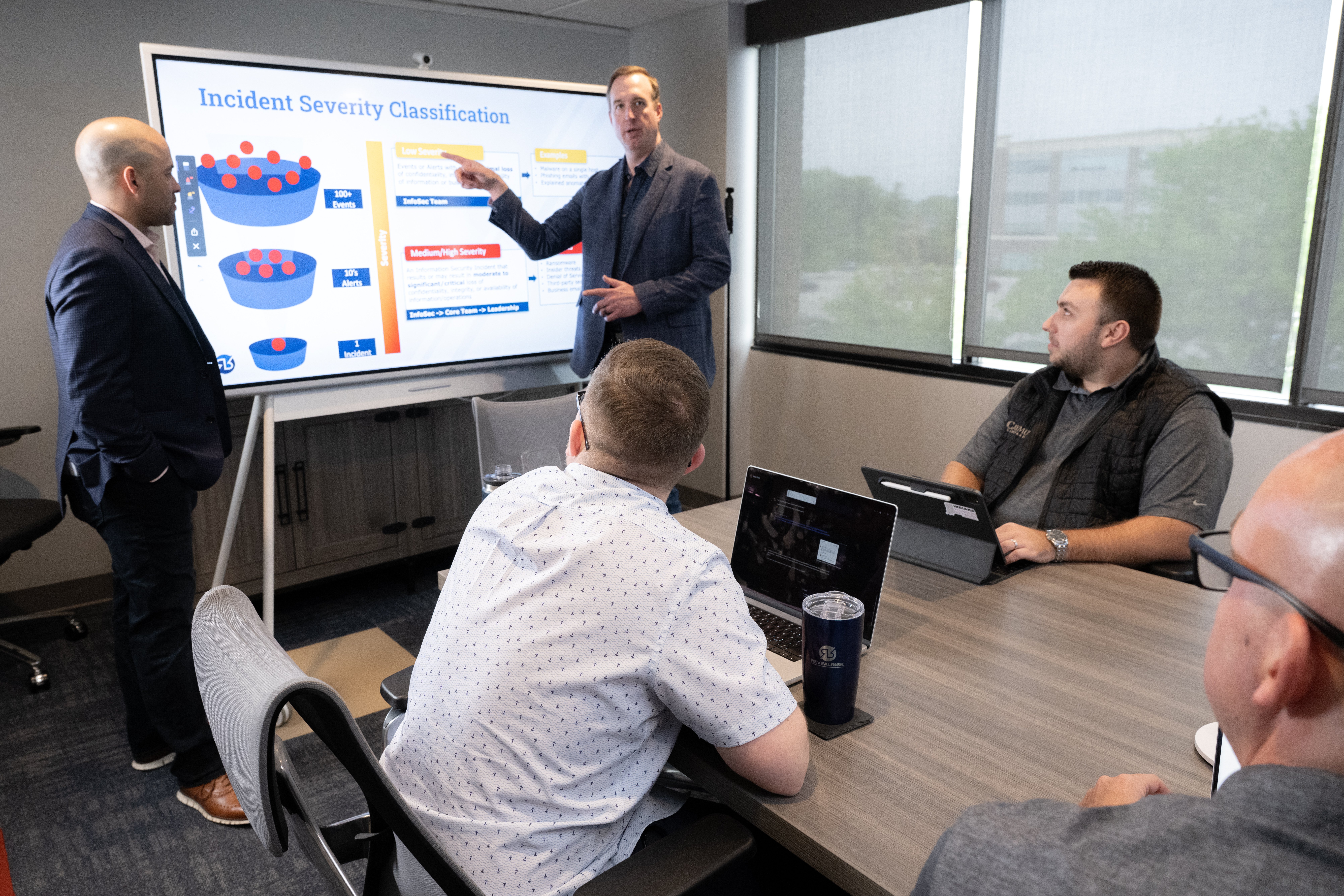
We interview stakeholders across the business to understand the real nature of the information they handle, where confusion shows up today, and what level of simplicity the future-state model needs.
Draft a right-sized classification model tailored to the business
We build a tailored taxonomy and label structure that simplifies decisions, reduces confusion, and aligns labels to sensitivity, handling expectations, and downstream controls where they matter.
Test the model with engaged users before broad rollout
We validate the framework with real users, real examples, and real business scenarios so the program can be adjusted before it becomes an enterprise-wide frustration point.
Refine the program using user and stakeholder feedback
We incorporate pilot feedback, clarify edge cases, tighten handling guidance, and improve the user experience so the program is simpler, clearer, and more durable at scale.
Support implementation and enterprise rollout without unnecessary disruption
We help move the program into the environment, support rollout planning, and provide guidance that helps users adopt the model with more confidence and less friction. Depending on scope, that can include implementation planning, training support, tool guidance, and post-launch changes.
What you walk away with.
An information classification engagement with Reveal Risk is built for your immediate and practical use. We believe you should walk away with more than just a taxonomy and a slide deck. Our team will arm you with a practical structure for data labeling and handling, program rollout, and a plan for long-term use across the parts of the business that need it most.

- Classification taxonomy tailored to your environment
- Classification policy and supporting procedures
- Labeling guide with clear definitions and use guidance
- Handling guide that connects labels to expected actions
-
Functional-area examples that make classification more concrete for users
-
Pilot feedback loop and refinements before wider rollout
-
Change management and training support materials
-
Implementation roadmap aligned to business criticality and risk
- Governance model for sustaining the program over time
- Tool and configuration guidance where classification needs to connect to technical controls
- A stronger foundation for DLP, sensitivity labels, access decisions, and AI governance
Frequently asked questions about Information Classification.
Buy-in improves when the taxonomy is right-sized, the labels make sense to the business, real users are included early, and the rollout is supported with examples, training, and change management. Programs that begin with heavy technical restriction and little business context usually lose trust faster than they build it.
Get the latest from our team.