Skip to content

Beyond an assessment.

Many organizations know they need a clearer view of cyber risk. They may face board questions, customer due diligence, regulatory expectations, an upcoming audit, a growth initiative, or simply too many competing security investments.

But a gap report alone does not answer the harder questions:

  • Which weaknesses create the greatest business risk?
  • What does “good enough” maturity look like for our organization?
  • What should we fix first, defer, fund, or stop doing?
  • Who owns each initiative, and what has to happen before it can begin?
  • How do we explain the plan to executives, the board, and operational teams?

Reveal Risk helps answer those questions through a NIST CSF 2.0 assessment designed to become a decision-ready strategy and roadmap—not just a collection of scores.
69

Engagement choices.

Start with the clarity you need. Build toward the outcomes you want.


Move from Assessment to Full Strategy.

Watch the video & grab the executive brief.
See what comes next

Lorem ipsum dolor sit amet, consectetur adipiscing elit, sed do eiusmod tempor incididunt ut labore et dolore magna aliqua. Ut enim ad minim veniam quis nostru.

Name Lastname | Company

Lorem ipsum dolor sit amet, consectetur adipiscing elit, sed do eiusmod tempor incididunt ut labore et dolore magna aliqua. Ut enim ad minim veniam quis nostru.

Name Lastname | Company
Product feature one
Product feature one
Product feature one
Lorem ipsum dolor sit amet, consectetur adipiscing elit.
What it is

Lorem ipsum dolor sit amet, consectetur adipiscing elit, sed do eiusmod tempor incididunt ut labore et dolore magna aliqua. Ut enim ad minim veniam, quis nostrud exercitation ullamco laboris.

What to expect
  • Lorem ipsum dolor sit amet, consectetur adipiscing elit.
  • Sed do eiusmod tempor incididunt ut labore et dolore magna aliqua. Ut enim ad minim veniam.
  • Quis nostrud exercitation ullamco laboris nisi ut aliquip ex ea commodo consequat.
  • Duis aute irure dolor in reprehenderit in voluptate velit esse cillum dolore eu fugiat.
Tab Image
Lorem ipsum dolor sit amet, consectetur adipiscing elit.
What it is

Lorem ipsum dolor sit amet, consectetur adipiscing elit, sed do eiusmod tempor incididunt ut labore et dolore magna aliqua. Ut enim ad minim veniam, quis nostrud exercitation ullamco laboris.

What to expect
  • Lorem ipsum dolor sit amet, consectetur adipiscing elit.
  • Lorem ipsum dolor sit amet, consectetur adipiscing elit.
  • Lorem ipsum dolor sit amet, consectetur adipiscing elit.Lorem ipsum dolor sit amet, consectetur adipiscing elit.
Tab Image
Lorem ipsum dolor sit amet, consectetur adipiscing elit.
What it is

Lorem ipsum dolor sit amet, consectetur adipiscing elit, sed do eiusmod tempor incididunt ut labore et dolore magna aliqua. Ut enim ad minim veniam, quis nostrud exercitation ullamco laboris.

What to expect
  • Lorem ipsum dolor sit amet, consectetur adipiscing elit.
  • Lorem ipsum dolor sit amet, consectetur adipiscing elit.
  • Lorem ipsum dolor sit amet, consectetur adipiscing elit.
  • Lorem ipsum dolor sit amet, consectetur adipiscing elit.
  • Lorem ipsum dolor sit amet, consectetur adipiscing elit.
Tab Image
Accordion Heading1
Lorem ipsum dolor sit amet, consectetur adipiscing elit.
What it is

Lorem ipsum dolor sit amet, consectetur adipiscing elit, sed do eiusmod tempor incididunt ut labore et dolore magna aliqua. Ut enim ad minim veniam, quis nostrud exercitation ullamco laboris.

What to expect
  • Lorem ipsum dolor sit amet, consectetur adipiscing elit.
Tab Image
Accordion Heading2
Accordion Heading3

Frequently asked questions.

Key feature of this service

Assessment details.

A detailed view of program maturity.


Reveal Risk evaluates your cybersecurity program across the 106 controls in NIST CSF 2.0. We provide maturity analysis at the control, category, and function levels, giving leaders both the enterprise-level picture and the operational detail needed to act. 

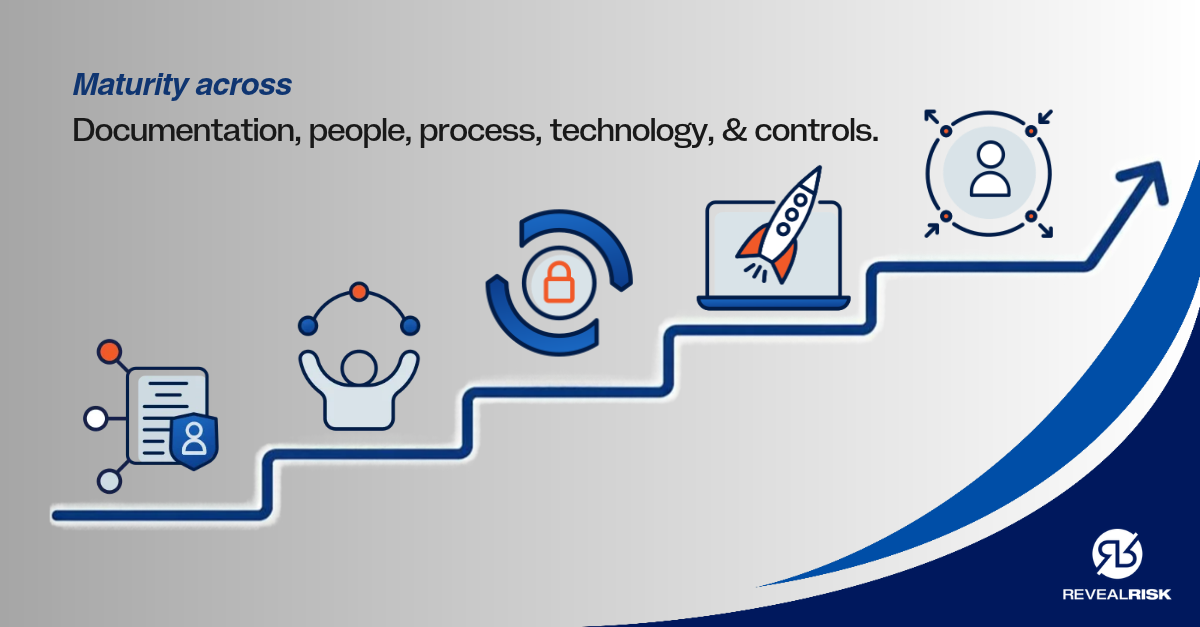
Our CMMI-aligned maturity approach looks beyond whether a policy exists or a tool has been purchased. We evaluate the layers that determine whether a control is effective and sustainable:

Structured Blue Nodes With Orange Accent
Documentation
People
Process
Technology
Control coverage

The process

Align on objectives and scope
Review evidence and program context
Engage the people who operate the program
Assess, score, and validate
Prioritize and communicate next moves
We clarify the business drivers, risk concerns, relevant stakeholders, and desired outcomes for the engagement.

Whether the priority is supporting growth, addressing regulatory expectations, or preparing for leadership investment decisions, those drivers shape the scope and depth of the work. Together, we establish priorities, participation needs, and an engagement rhythm that accounts for your team’s capacity and key business deadlines.

We review available documentation, policies, standards, technologies, operating processes, and prior findings to focus conversations where they matter most.

We start with what you already have, focusing evidence requests on materials relevant to the agreed scope rather than asking your team to recreate documentation for the assessment. This review helps us identify what needs clarification, avoid repeating work already completed, and prepare focused questions for stakeholder discussions.

Through stakeholder interviews and collaborative workshops, we understand how controls work in practice—not only how they are described on paper.

We tailor participation based on your business drivers, current maturity, available evidence, and stakeholder availability. Typical participants may include security, IT, GRC, compliance, risk, and selected business leaders.

We evaluate maturity across NIST CSF 2.0, identify meaningful strengths and gaps, and validate findings with the people closest to the work.

We connect findings to the supporting evidence and operational context so your team can understand the reasoning behind the assessment, not just the scores. Focused validation discussions give relevant stakeholders an opportunity to clarify gaps, resolve differing perspectives, and distinguish documentation issues from weaknesses in how the program operates.

We deliver clear results and, where needed, translate them into a practical strategy, roadmap, and initiative-level plans.

Recommendations account for business impact, dependencies, budget, and team capacity, helping you distinguish immediate priorities from longer-term improvements. Where strategy and roadmapping are included, we clarify sequencing, ownership, and resource needs so leadership can make informed investment decisions and your team can move from findings to execution.

Align on objectives and scope
Vector 22
We clarify the business drivers, risk concerns, relevant stakeholders, and desired outcomes for the engagement.

Whether the priority is supporting growth, addressing regulatory expectations, or preparing for leadership investment decisions, those drivers shape the scope and depth of the work. Together, we establish priorities, participation needs, and an engagement rhythm that accounts for your team’s capacity and key business deadlines.

Review evidence and program context
Vector 22
Engage the people who operate the program
Vector 22
Assess, score, and validate
Vector 22
Prioritize and communicate next moves
Vector 22
332294

You've Baselined. Now, Build.

Full program builds, strategy, and roadmapping built on a rock-solid foundation. Turn NIST CSF 2.0 assessment findings into an executable plan for the cybersecurity program ahead.

How it Works

We use NIST CSF 2.0 as a foundation, then translate assessment findings and business context into strategic priorities, defined initiatives, governance considerations, and a phased roadmap. 

A detailed assessment can uncover dozens of gaps. But no organization can (or should) treat every gap as equally urgent. 

We turn findings into a manageable set of risk-based strategic initiatives. We help identify what will reduce the most meaningful risk, support critical business operations, address regulatory or customer expectations, and create the foundation for long-term program maturity. 

Rather than handing leadership a long list of disconnected findings, we organize related work into clear initiatives, such as identity and access management, security monitoring and response, data protection, resilience, governance, or third-party risk. We acknowledge dependencies and can advise on the real order of operations that would affect your program the most.   

The result is a strategy that works at every level: clear enough for executives to understand and sponsor, structured enough for security and IT leaders to manage, and practical enough for working teams to activate. 

 

Full Cybersecurity Program Builds, From Scratch.

Starting from scratch? We can start with strategy.


No need for you to waste time or money on assessing things that don’t exist.  

A NIST CSF 2.0 assessment is a valuable foundation when an organization has an established cybersecurity program to evaluate. But it is not a prerequisite for every engagement. 

If your program is early-stage, in the middle of change, or perhaps doesn’t even exist yet, Reveal Risk can help build it from the ground up. We will use NIST CSF 2.0 controls and other relevant guidance to inform the work, but we will not spend your time and budget formally assessing capabilities that haven’t been built yet. 

Instead, we begin with your business, risk profile, regulatory requirements, critical operations, existing technology, and growth plans. From there, we define the foundational capabilities, governance, policies, processes, ownership, and prioritized initiatives needed to establish a practical cybersecurity program. 

The result is a right-sized plan for building security capability where it matters most—not a report documenting what you already know is missing. 

22221

NIST CSF Assessment FAQs. 

315719
What is a NIST CSF 2.0 assessment?
Is a NIST assessment the same as an audit?
What does a NIST CSF 2.0 assessment include?
How is Reveal Risk’s assessment different from a checklist or compliance review?
Do we need a NIST CSF assessment before building a cybersecurity program?
What does a cybersecurity program build include?
How do you turn assessment findings into a roadmap?
What frameworks do you cover?
What does the roadmap look like?
How long does an assessment or program strategy engagement take?

How can we help you?

Get the latest from our team.

Blog | Reveal Risk
October 01, 2026
Reveal Risk
Reveal Risk
Blog | Reveal Risk
September 28, 2026
Chris Adickes
Chris Adickes
Blog | Reveal Risk
September 25, 2026
Reveal Risk
Reveal Risk
Blog | Reveal Risk
September 22, 2026
Aaron Pritz
Aaron Pritz